
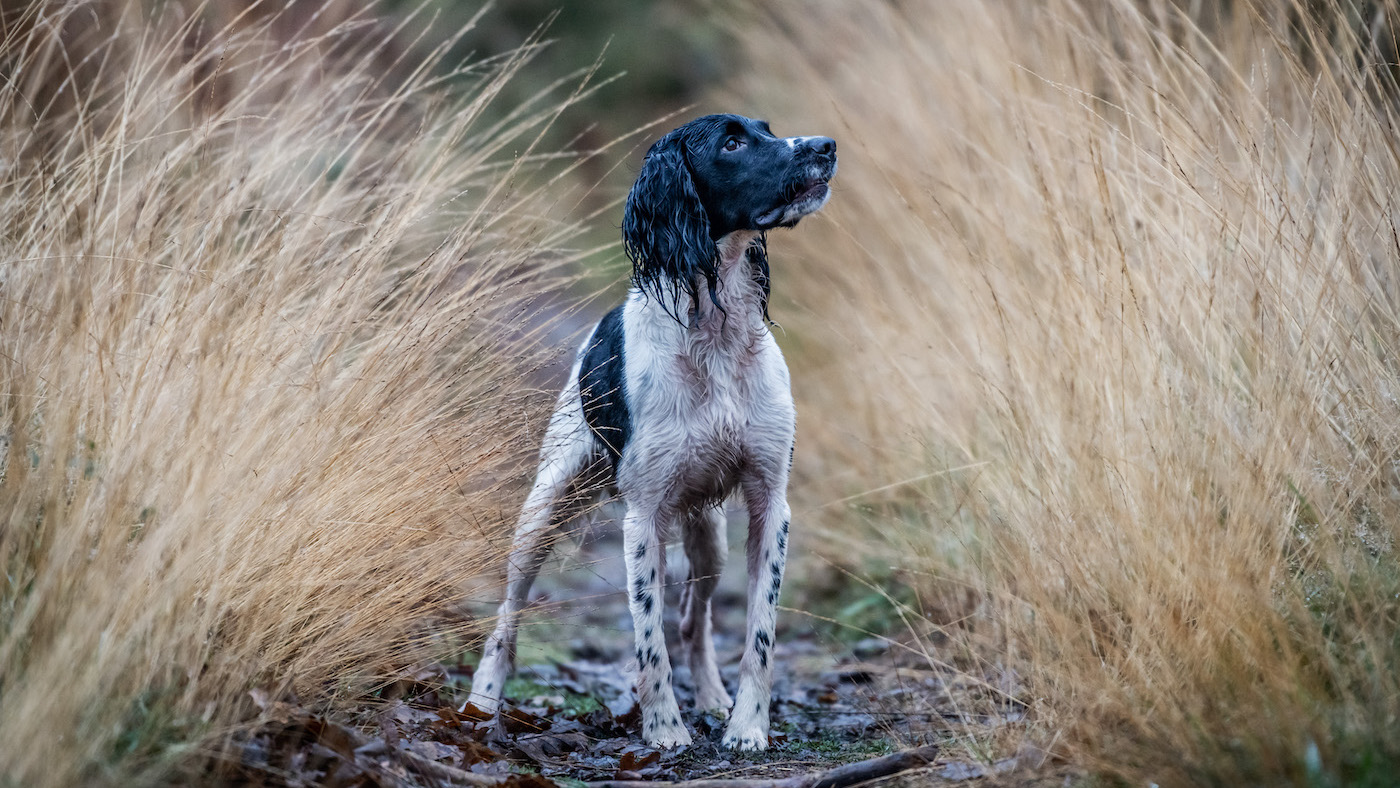
Working English Springer Spaniel Training, Temperament & Buying Guide (UK 2026)
This is the honest UK handler's guide to the working English Springer Spaniel: temperament, drive control, working vs show lines, the stop-whistle priority, the quartering pattern, the 2026 health-test non-negotiables, and what to check before you buy. The single most returned breed in rough shooting, almost always because the buyer didn't know what they were buying.
Quick answer: what makes a working English Springer Spaniel?
- Working line, not show line (different pedigrees, lean build, tighter coat)
- Stop whistle drilled rock-solid before the dog ever sees live game
- Quartering pattern within 25 yards of the gun, windscreen-wiper across the wind
- Steady to flush (drop to wing) before introduction to live birds
- Health clearances: hips, elbows, current eye certificate, Fucosidosis clear
Written by UK gundog handlers and trainers working regularly with working-line English Springer Spaniels in rough-shooting, picking-up, and field-trial environments. Cross-referenced with The Kennel Club's breed standards and British Veterinary Association (BVA) Canine Health Schemes for hip, elbow, and eye testing protocols.
The working English Springer Spaniel is one of the most effective hunting dogs in the UK, but also one of the easiest to get wrong without proper training and breeding knowledge. This guide covers what separates a working springer from a show one, the training brake that comes before the accelerator, the 2026 health-test non-negotiables, and the buying checklist that prevents twelve months of regret.
Jump to section
- Temperament & drive
- Quartering pattern
- Working vs show line
- Training (stop whistle)
- Health tests (UK)
- Buying checklist
- FAQs
Mid-October, rough day on a Suffolk farm. Wind across the stubble, a strip of blackthorn and bramble running down to a ditch. My old springer is in there somewhere. Can't see him. Can't hear him.
One pip on the whistle and the bramble shakes. He has turned on a sixpence twenty yards in, cut back across my front, and is already boring a fresh hole through the cover. Thirty seconds later a cock pheasant rockets out. The gun behind me drops it. The dog is sat in the ditch waiting for the send. He has done four hundred yards of hunting in under a minute and burned no petrol he didn't need to.
That is why people fall in love with English Springer Spaniels. It is also why they are the single most returned, rehomed, and ruined breed in the rough-shooting world. Bred wrong, raised wrong, or trained wrong, what you end up with is not a working spaniel. It is a brown and white missile running riot two counties away while you blow a useless whistle.
Working English Springer Spaniel Temperament: Drive, Energy & Control
Short answer: a working English Springer Spaniel is a high-drive UK hunting dog bred for flushing game, requiring structured training, rock-solid stop-whistle control, and a quartering pattern within 25 yards of the handler. The drive is genetic; the off-switch is trained.
If a Labrador is a luxury saloon (patience, calculation, measured power), a working English Springer Spaniel is a rally car. The cliché is a cliché for a reason.
A good springer hunts with frantic, systematic joy. Head down, tail going like a metronome, working the ground in a proper quartering pattern, checking on the handler every few yards, exploding forward the second the scent line gets interesting. A great springer does all that and comes back on the whistle without argument. A bad one does the first bit and ignores everything else.
Drive is genetic. Biddability is partly genetic, partly trained. Buy from lines where both have been preserved. Buy from breeders who can show you parents that work hard and stop on a whistle.
Working Springer Spaniel Quartering: Staying Inside the Killing Zone
Short answer: a working springer should quarter within 20 to 25 yards of the handler in a windscreen-wiper pattern across the wind. Hunting beyond that range puts birds up out of gun range, defeating the purpose of a working spaniel.
Working Springer Quartering Pattern (Killing Zone) 25 yard killing zone Handler Gun (behind) turn turn left cast right cast wind Windscreen-wiper quartering pattern: dog stays within 25 yards of handler, turning on the whistle at each cast.
This is the bit novices get wrong. A springer that is hunting forty, fifty, sixty yards out in front of the gun is not working, he is self-employed. He is putting birds up for himself, not for the gun. Every pheasant he flushes out of range is a bird nobody is going to shoot, and a reinforcement for the dog that running on pays off.
You want the dog hunting within range. Twenty to twenty-five yards out, either side of the handler, working a windscreen-wiper pattern across the wind. Left to right, right to left, checking back on the handler, tight and methodical. That is the killing zone.
The pattern doesn't happen by accident. It is built in from eight weeks of age with planted scent lines, quartering drills on open ground, and hundreds of repetitions of the turn whistle (one pip, dog swings back across the front, resumes hunting in the opposite direction). If the breeder hasn't started that work, or the trainer hasn't followed through, you will spend two seasons fixing it.
Working vs Show English Springer Spaniel: Key Differences
Short answer: the working English Springer Spaniel is smaller, leaner, faster, with a tighter coat and shorter ears bred for the field. The show line is bigger and heavier with sopping feathered ears bred for the ring. They have diverged for 40+ years and now function as separate breeds.
Working vs Show English Springer Spaniel Working ESS lean, tight coat, short ears Show ESS heavier, blockier, sopping ears Visual comparison: working line bred for the field, show line bred for the ring.
Be blunt about this. The show English Springer Spaniel and the working English Springer Spaniel are effectively two different breeds that happen to share a name and a Kennel Club register. They have been diverging for forty years. At this point a show-bench ESS and a working ESS stood next to each other don't look related.
| Feature | Working ESS | Show ESS |
|---|---|---|
| Build | Smaller, leaner, faster | Bigger, heavier, blockier |
| Coat | Tighter, practical, shorter feathering | Long, heavy, ring-show feathering |
| Ears | Shorter, less feathering, less burr-collection | Long, sopping, drag in puddles and brambles |
| Head | Refined, alert | Blockier, heavier |
| Drive | Bred for game-finding, nose, biddability | Bred for movement and conformation |
| Pedigree markers | FTCh, working test winners (Lyons, Chasehills, Helmlake) | Show-ring titles, no FTCh |
| Best for | Rough shooting, picking-up, wildfowling, working tests, field trials | Family pet, conformation showing, casual countryside walks |
If the advert says "English Springer Spaniel puppies, Kennel Club registered, lovely nature" and there is no mention of working parents, no FTCh anywhere in the pedigree, no working tests or trials cited, assume it is show breeding or show/pet crossover. Lovely dogs for the family walk. Completely wrong for the rough-shooting field. Know which one you are buying.
Training a Working English Springer Spaniel: Why the Stop Whistle Comes First
Short answer: you don't need to teach a springer to go. You need to teach him to stop. The drive is genetic. The off-switch is trained. Stop-whistle work must be reflex-level before the dog ever smells a pheasant.
This is the single most important sentence in any springer training book: you do not need to teach a springer to go. You need to teach him to stop.
The drive is genetic. The off-switch is trained. A springer that has been let hunt before the stop whistle is rock solid is a springer that will ignore the stop whistle the first time he hits scent on a live bird. Once that happens, you are on a twelve-month rebuild project with a dog who has learned he can win the argument. Don't start down that road.
The stop whistle (one pip, backside down, wherever he is, whatever he is doing, at any range, under any level of distraction) must be absolutely solid before the dog ever smells a pheasant. The full drill is in the gundog stop whistle training guide. Drill it on the lawn. Drill it in the field. Drill it with thrown dummies, with rabbits in a pen, with a placed dummy on the other side of a hedge. Only when it is 100% on every scenario do you introduce live game.
Pair stop-whistle work with reliable gundog recall training in the presence of game and steady-to-shot training. The three drills together are the control set every working springer needs.
The Red Zone: Managing Springer Spaniel Drive Under Pressure
Short answer: the red zone is the arousal point where adrenaline has flooded the system, the thinking brain is offline, and the dog cannot process the whistle. Train below the red zone and push the threshold higher over months.
Every working springer has a red zone. It is the point where the scent is hot, the dog's adrenaline has topped out, and his ears have gone offline. The whistle becomes background noise. The handler becomes irrelevant.
A well-trained dog keeps the red zone under control. He stays within range, turns on the whistle even when his eyes are rolling back, and hups the moment a bird flushes because the steadiness has been drilled in harder than the drive. A poorly trained dog (or a dog from lines where drive has been pushed at the cost of biddability) hits the red zone on the first hot scent of the day and you don't see him again until lunchtime.
You can see red-zone risk from the way a pup works at six months. Hunting hard is good. Hunting deaf is a warning. If the pup ignores the handler entirely once he is on scent, that is a dog that needs serious foundation work before he ever goes in the field, and some of them never fully come back from it. Be honest about what you are looking at.
English Springer Spaniel Health Tests (UK Non-Negotiables)
Short answer: hip score, elbow grade, current BVA eye certificate, plus DNA tests for GPRA, Fucosidosis, PFK, and AMS where relevant. Both parents. No paperwork = no purchase.
| Test | What it screens | Ideal result |
|---|---|---|
| BVA/KC Hip Score | Hip dysplasia | Total at or below breed mean (around 12 to 14). Lower is better. |
| BVA/KC Elbow Grade | Elbow dysplasia | Grade 0 on both parents |
| BVA Eye Certificate (annual) | Hereditary cataract, goniodysgenesis, retinal dysplasia | Current within 12 months on both parents, Unaffected |
| DNA: GPRA (cord1 PRA) | Generalised progressive retinal atrophy | Clear, or Clear × Carrier. Never two Carriers. |
| DNA: Fucosidosis (Fuco) | Fatal neurological storage disease | Clear, or Clear × Carrier. Never two Carriers. |
| DNA: PFK | Phosphofructokinase deficiency, exercise intolerance | Clear, or Clear × Carrier |
| DNA: AMS (where relevant) | Acral Mutilation Syndrome | Clear on both parents |
Fucosidosis red flag: it is fatal, it has been testable for decades, and there is no excuse for any ESS breeder not having clear status documented on both parents. If Fuco is not listed in the advert, ask. If the breeder doesn't know what it is, walk away. Full paperwork rundown in the gundog health testing guide.
Steady to Flush: The Working Springer's Other Essential Skill
Short answer: the dog flushes game and sits the moment the bird lifts. Drop to flush, sit to wing. Drilled in alongside the stop whistle, with thrown dummies, then cold game, then warm game, before live birds.
A working springer flushes game. That is the job. But he has to flush it and sit (drop to flush, sit to wing, whatever terminology your trainer uses) the moment the bird lifts.
A springer that chases flushed game is a nightmare in the field. He is out of range before the gun is up, through the hedge and on to the next bird, teaching himself every wrong lesson at once.
Steady to flush is drilled in alongside the stop whistle. Thrown dummies, then cold game, then warm game, then the dog finally sees a live flushed bird and the foundation is so deep he just sits. Any decent part-trained ESS advert will mention this explicitly: "steady to flush and shot on live game". If it doesn't, it hasn't been done. Ask. Insist. Watch the dog prove it before you buy.
Summer Conditioning for a Working Springer
Short answer: 12 weeks of progressive roadwork April to August, plus water work for wildfowling-capable dogs. A soft springer in October will hurt himself in week one.
Springers come out of the off-season soft. The fitness side of summer prep is non-negotiable for a dog that is going to hunt cover for six hours a day in October. Two summer pillars:
- Gundog roadwork and pad conditioning: 12-week schedule, the 7-second hand-on-tarmac rule, proprioception work for rough ground
- Gundog water training: confidence, the shake rule, blue-green algae safety, breed-specific notes for spaniels
Before You Buy a Working English Springer Spaniel
Short answer: proven working pedigree, watched parents work, full health paperwork (hips + elbows + eyes + Fuco + GPRA + PFK), no FTCh in the line is a yellow flag, no Fucosidosis clear status is a red flag.
Go in with your eyes open. A working ESS will give you more sport per acre than almost any other UK breed (rough shooting, wildfowling, picking-up, the lot) but only if he is bred from the right lines and trained from the ground up with the brake installed before the accelerator.
The buyer's checklist:
- Proven working breeder. FTCh, working test winners, working pedigree on both sides
- Watch the parents work if you can. Quartering, stop-whistle response, recall under distraction
- Full health paperwork. Hips, elbows, current eye, Fucosidosis, GPRA, PFK clearances
- No cute-litter-photo purchases. A cute litter and "they're all working lines, mate" is not a pedigree
- Walk away from missing Fuco status. Non-negotiable
Browse working Springer Spaniel puppies for sale UK, part-trained Springer Spaniels, or fully trained Springer Spaniels on Gun Dogs Hub. Read the part-trained gundog meaning guide before you decide which tier suits you, and the buy trained gundog UK 2026 guide for timing and seller red flags.
If you are still choosing between breeds, the Cocker vs Springer comparison covers ground type, drive, and handler suitability.
Ready to Buy a Working English Springer Spaniel?
Skip the puppy lottery. Browse working-pedigree springers from licensed UK breeders, with health paperwork verified before listings go live:
- View available working Springer Spaniel puppies UK (FTCh-line breeders)
- Compare part-trained Springer Spaniels (foundation drills already done)
- Browse fully trained Springers ready to work (steady, quartering, on game)
- Buyer's checklist: timing, prices, red flags
View Available Working Springers
The Complete UK Gundog Training System
Owning a working springer means working through the full training system. Each piece below stacks on the next:
- Gundog stop whistle training: the foundation control cue every springer needs first
- Gundog steady to shot training: hold position through shot, fall, and distraction
- Gundog recall training in the presence of game: reliable recall under live-game pressure
- Gundog water training: confidence and the shake rule for wildfowling
- Gundog roadwork and pad conditioning: summer fitness for the season
FAQs: Working English Springer Spaniel
Are working English Springer Spaniels good hunting dogs?
Quick answer: working-line English Springer Spaniels are among the best UK hunting dogs for rough shooting, picking-up, and wildfowling. Show-line ESS are not bred for the field and are not suitable for serious work.
The working line has been selected for nose, drive, biddability, and quartering pattern over decades. The show line has been selected for conformation, coat, and ring movement. They are effectively different breeds at this point. Buy working pedigree if you want a hunting dog.
Are working English Springer Spaniels hard to train?
Quick answer: not hard, but unforgiving of cut corners. The brake (stop whistle, recall, steadiness) must be installed before the accelerator is engaged on live game. Skip the foundation work and you will spend a year fixing it.
Springers are biddable when bred from the right lines. The training challenge is not the dog's intelligence, it is the handler's discipline to drill the off-switch hard enough that it holds under live-game pressure.
What is the difference between working and show English Springer Spaniels?
Quick answer: working ESS is smaller, leaner, faster, with a tighter coat and shorter ears bred for the field. Show ESS is bigger, blockier, with heavy feathered ears bred for the ring. They have diverged for 40+ years.
Pedigree-wise, working lines carry FTCh and working test titles (Lyons, Chasehills, Helmlake). Show lines carry conformation titles. The two have been bred in separate gene pools for so long that crossing them produces neither type cleanly.
How much exercise does a working English Springer Spaniel need?
Quick answer: 1.5 to 2 hours of structured exercise daily as an adult, plus mental work. A bored working springer is a destructive springer. Off-season conditioning and seasonal work both required.
Working lines have higher exercise needs than show lines. Through the off-season, daily roadwork, hunting drills, and water work keep the dog in condition. Through the season, a full shoot day handles the requirement.
What health tests should a working English Springer Spaniel have?
Quick answer: BVA/KC hip score, BVA/KC elbow grade, current BVA eye certificate (within 12 months), DNA tests for GPRA, Fucosidosis, and PFK. AMS where relevant. Both parents.
Fucosidosis clearance is non-negotiable: it is fatal, has been testable for decades, and any breeder without documented clear status on both parents is not a serious working breeder.
At what age does a working springer start working?
Quick answer: foundation work from 8 weeks. Quartering drills from 6 to 12 months. First live-game work from 10 to 14 months once stop whistle and steadiness are reflex-solid. Full picking-up day from around 18 months.
Rushing the timeline produces dogs that ignore the whistle on hot scent. The biology of associative learning is not negotiable: foundations first, live game last.
Can a working English Springer Spaniel be a family pet?
Quick answer: only with serious daily exercise and mental work. A working springer in a pet home that doesn't meet his drive needs becomes destructive, anxious, or both. Show-line springers suit pet homes better.
Working springers can be lovely with families when their work needs are met. They cannot be left as a sofa dog: the drive does not switch off because you got home from the office tired. Match the dog to the lifestyle honestly before buying.
How much does a working English Springer Spaniel cost UK?
Quick answer: £1,200 to £2,000 for a working-pedigree puppy. £2,500 to £3,800 for part-trained. £4,000 to £6,500+ for fully trained. Field-trial winners and FTCh-bred dogs sit at the top end.
Cheap working springers are usually not from working lines. The breeders investing in health testing and FTCh-line pedigree do not undercut the market. Pay for pedigree once, or pay for problems for ten years.