
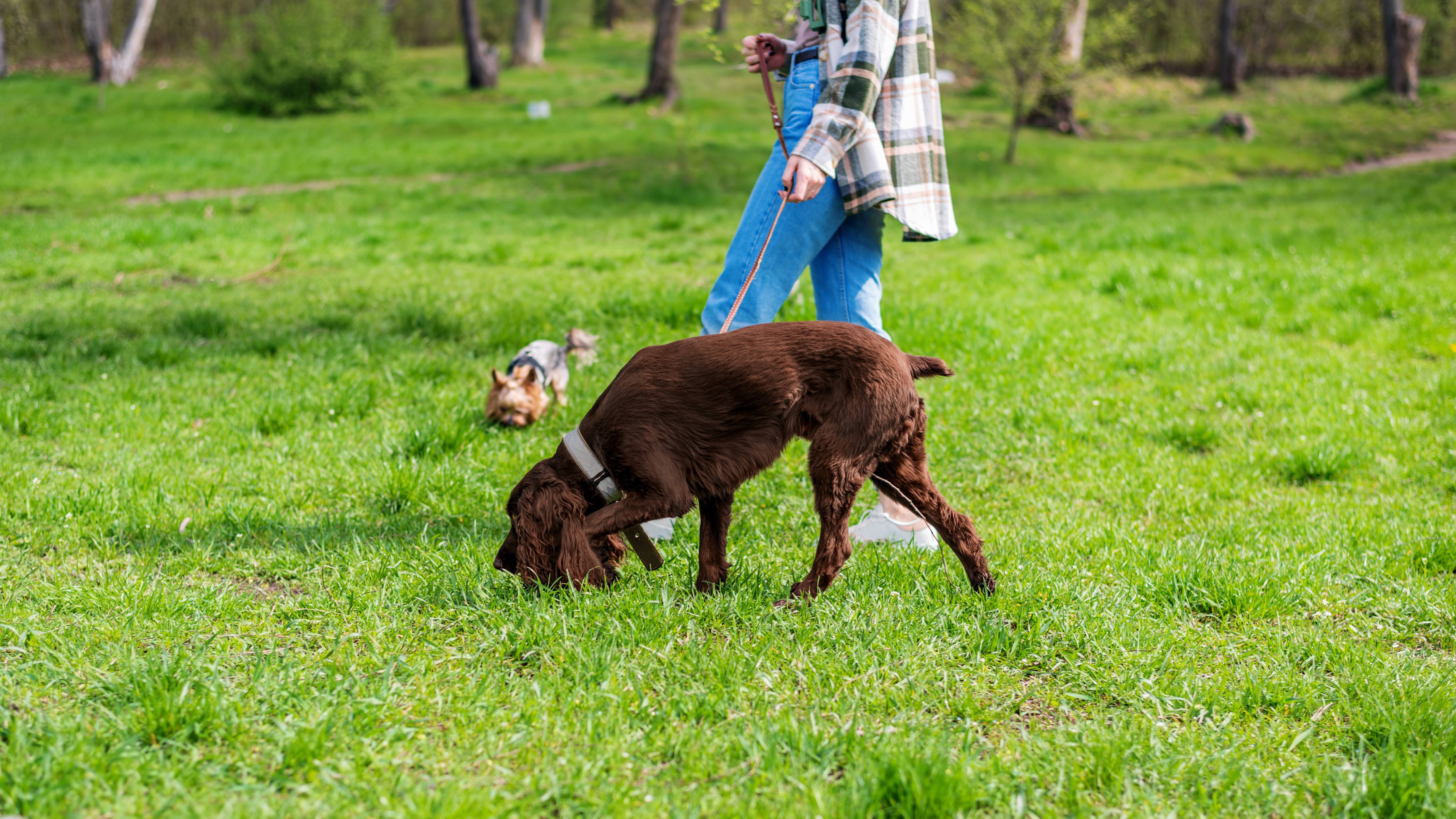
Why Your Gundog Keeps Breaking on the Shot (And How to Fix It Fast)
This is the honest UK handler's guide to gundog steady to shot training: why young dogs keep breaking on the retrieve, the proven 3-to-1 Rule that fixes it fast, how to introduce the starting pistol without creating a gun-shy dog, and the eight mistakes that wreck steadiness. Stop your gundog breaking on the shot before October, not during it.
Quick answer: how to stop a gundog breaking on the shot. Use the 3-to-1 Rule. For every retrieve your dog gets, throw three dummies you walk out and collect yourself while the dog sits and watches. Delay every send by 10 seconds after the dummy lands. This simple pattern breaks the automatic "fall equals go" trigger and builds reflex-level steadiness in six to twelve weeks.
The bang goes off and the dog's backside leaves the grass like it is spring-loaded. Gone. Forty yards out before you have even opened your mouth. The dummy is still in the air and he is already underneath it, jumping, snatching, tearing back towards you with his tail going and his eyes wild.
You are standing there, red-faced, shouting something that is not a command, while everyone on the line pretends not to notice. The keeper looks at you. The bloke next to you in the beating line shuffles his dog a bit closer to his boot, just to make a point.
You built that. Every single retrieve you let him have the moment the dummy hit the ground, you were wiring his brain. Bang equals run. Throw equals mine. You built a spring, tightened it all summer, and it just snapped in front of an audience.
Steadiness to shot is not natural. No dog is born wanting to sit still while a bird crashes into the ground thirty yards away. The Kennel Club defines a steady gundog as one that holds position through shot, fall, and distraction until sent by the handler, and that standard is the benchmark every working test judge uses. Every fibre of a gundog, every instinct, every scrap of breeding that makes them a working dog, is screaming go. Your job is to teach them that "go" only happens when you say it does.
8 Mistakes That Keep Your Gundog Breaking on the Shot
Short answer: almost every unsteady dog is the product of the same eight errors. Read these first: if you recognise two or more, that is your fix list.
- Every throw is a retrieve. Most common mistake on the training field. If the dog gets every dummy, you have built a spring-loaded dog. 3-to-1 minimum.
- Sending on the fall. Dummy hits the ground, handler sends immediately. The dog never learns to wait. Count to ten on every retrieve.
- Using a dummy launcher as a toy. Launcher fires, dummy flies, handler sends. Three sessions and the launcher has become the biggest trigger in the dog's world.
- Shouting when the dog breaks. Bellowing looks like excitement, not correction. Walk to the dog, reset, silence.
- Starting the gun too close. A gun-shy dog will not leave the truck. Start at 50+ yards with a helper.
- No helper. You cannot fire a pistol and watch the dog at the same time. Join a gundog training club or find a partner.
- Training steadiness only with noise. Bang without throw teaches nothing. The fall is the real trigger.
- Training to breaking point. Any session where the dog breaks three or four times is one where you have gone too fast.
Bottom line: handlers who only ever throw-and-send build dogs that cannot stay steady. Every retrieve you let the dog have the moment the dummy lands is a rep that wires "fall equals go." Fix the pattern before you fix the dog.
Why Gundogs Break on the Shot (The Real Trigger Explained)
Short answer: the visual, not the bang. The throw, the arc, the fall is what loads the dog's launch. Train the throw first, the noise second.
Most people think the gunshot is what makes a dog break. It is not. Not usually. Watch a dog that is unsteady and watch carefully. It is not the bang that sends him. It is the visual. The arm going back. The throw. The fall. The moment something leaves your hand and arcs through the air, the dog's eyes lock on, the body loads, and the brain says now.
The bang comes first, and yes, the dog reacts to it, ears prick, body tenses. But it is the sight of the dummy or the bird falling that triggers the launch. Which is why you can have a dog that is perfectly steady to a starting pistol in the garden but breaks the instant you throw a tennis ball.
This changes how you train. If you only practise steadiness to noise, banging a cap gun, firing a dummy launcher, you are training for the wrong stimulus. You need to train for the throw. For the fall. For the sight of something hitting the ground and the dog choosing not to move. That is what proper steadiness training for gundogs looks like.
The Proven 3-to-1 Rule for Steady Gundogs (Step-by-Step)
Short answer: throw three dummies you pick up yourself for every one retrieve the dog gets. The retrieve becomes a privilege, not a reflex. Combined with a 10-second delayed send, this is the core of effective gundog steadiness training.
Here is the rule that changed everything for me, and I wish someone had told me this twenty years ago instead of letting me figure it out the hard way. It is simple, it is proven, and it works on every working breed.
For every one retrieve your dog gets, you throw three that you pick up yourself while the dog sits and watches.
Three to one. Three for you, one for him. On that one retrieve, you do not send him the moment the dummy lands. You wait. Count to ten. Fifteen. Adjust your hat. Look at the sky. Make the dog look at you, not the fall. Then send him. Calmly. By name. One retrieve. Delivered to hand. Sit. Done.
What you are doing is turning the dummy throw into your event, not the dog's. The fall is not a trigger any more, it is just something that happens. Sometimes he gets sent. Most of the time he does not.
The retrieve becomes the forbidden fruit: rare, valuable, earned. A dog that sees the retrieve as a privilege is a dog that will wait for permission. That is how you stop a dog running in, on the training ground and on a real shoot day.
It is boring. You will be doing a lot of walking. Your legs will know about it. But steady dogs are built by handlers who walk, not handlers who throw. This works hand-in-glove with a rock-solid gundog stop whistle training drill: steadiness gives you the sit, the stop whistle gives you the sit at distance.
| Throw | Who gets it | What the dog learns |
|---|---|---|
| Throw 1 | You walk out and pick it up | A dummy landing is not automatically his business. Nothing happens for him. |
| Throw 2 | You walk out and pick it up | The connection between "fall" and "go" is being broken, deliberately, one throw at a time. |
| Throw 3 | You walk out and pick it up | By now the dog is expecting you to walk. Good. The throw has become your event, not his. |
| Throw 4 | Dog retrieves, but wait 10 seconds first | Send calmly, by name. One retrieve. The retrieve is a reward for three throws of patience. |
Starting Pistol Training: 6-Week Distance Plan for Gundogs
Short answer: start at 50+ yards with a helper, close the distance to 15 yards over six weeks, never fire close until the dog is fully desensitised at distance. A gun-shy dog is worse than an unsteady one.
Now, the noise. You need to introduce it, and you need to do it properly, because a dog that is gun-shy is worse than a dog that is unsteady. At least an unsteady dog wants to work. A gun-shy dog will not leave the truck. BASC (British Association for Shooting and Conservation) and other UK shooting bodies widely cite gun-shyness as a leading cause of working dogs being retired early from the shooting field, and it is almost always built by handlers who rushed the introduction.
| Week | Distance | Drill |
|---|---|---|
| 1 to 2 | 50+ yards | Helper fires the starting pistol at distance while the dog is eating or playing. Dog barely registers it. No reaction = move on. Any flinching = stay here longer. |
| 3 to 4 | 30 yards | Fire during a retrieve, the bang happens while the dog is running out or coming back. Dog should acknowledge the sound but not change behaviour. |
| 5 to 6 | 15 yards | Bang and throw together, but the dog does NOT retrieve. You pick up. 3-to-1 rule applies. Bang is now paired with the visual. |
| 7+ | At the handler | Full simulation. Bang, throw, dog sits, you decide whether to send or walk. Most throws, you walk. |
Start at fifty yards. Minimum. Get a helper: you cannot fire a pistol and watch the dog at the same time. The helper fires while the dog is doing something positive: eating, retrieving, playing. At fifty yards, the bang is background noise. The dog hears it, maybe flicks an ear, carries on. That is what you want. Acceptance. Not excitement, not fear.
Over weeks, not days, you close the distance. Thirty yards. The dog acknowledges it but does not change what it is doing. Good. Twenty yards. Fifteen. By now you are pairing the bang with a throw, but the 3-to-1 rule still applies.
The bang happens, the dummy lands, and the dog sits there while you walk out and pick it up. The bang is becoming part of the furniture. Not a trigger. Just noise.
Where people go wrong, and where remote dummy launchers cause absolute carnage, is rushing this. A dummy launcher at thirty yards, the bang goes off, the dummy rockets into the sky, the dog watches it arc and land, and the handler sends it immediately because it looks spectacular.
Three sessions of that and you have built an unsteady dog. The launcher becomes the biggest, most exciting trigger the dog has ever seen. Dummy launchers are brilliant tools. But they are the number one cause of breaking in young dogs because handlers use them as entertainment instead of training aids.
When Your Gundog Breaks: The 3-Step Reset Drill
Short answer: walk calmly to the dog (do not run, do not shout), return him to the exact spot where he broke, leave him ten seconds, do not send on the next three throws. Breaking gets him less, not more.
He will break. Every young dog breaks at some point. The dummy goes out, something switches in his brain, and he is gone. Do not panic. Do not shout. Do not stand there bellowing his name across the field like a market trader.
Step 1: Walk, do not run. Get to him quickly. Not running (that looks like a chase), but walking fast, with purpose. Get to the dog, take him by the collar or the scruff, and walk him back to exactly where he was sitting when he broke. Put him in a sit. Leave him there. Walk away. Carry on with whatever you were doing.
Step 2: No shouting. No smacking. No drama. You broke, so now you are back where you started with nothing to show for it. The retrieve, the thing he wanted, did not happen. That is the punishment. Not pain. Not anger. Missing out.
Step 3: Do not send on the next three throws. Three more throws, you pick up. Then maybe, if he has held his position and his brain has come back down from the ceiling, you send him. Maybe. Or maybe you pick up again and end the session there.
If he is breaking repeatedly, three or four times in a session, stop. You have gone too far, too fast. Go back to the garden. Go back to short throws with no bang. Go back to the food bowl if you have to. There is no shame in going backwards. There is plenty of shame in taking an unsteady dog onto a shoot and ruining someone's drive.
Skip the Training. Get a Dog That Is Already Rock-Steady at the Peg.
Not every handler has six months to build steadiness from scratch. If October is closer than you want to admit, buy a dog that is already trained: steady at the peg, steady to shot and fall, delivered to hand, ready for your first driven day of the season.
- Cut twelve months off your training calendar: browse fully trained Labradors for the 2026 season or fully trained Springer Spaniels ready to work
- Buy right, not twice: read the buy trained gundog UK 2026 guide (timing, prices, red flags)
- Know what you are paying for: the part-trained gundog meaning guide breaks down every training tier
- Bolt on the two other pillars of control: gundog stop whistle training and recall in the presence of game
The Payoff: What a Rock-Steady Dog at the Peg Looks Like
A steady dog at the peg is a thing of beauty. Birds falling around him, guns going off, other dogs running in, and he sits there. Watching. Marking the falls. Calm. Waiting for his name. When you send him, he knows exactly where to go because he has been watching the whole time instead of losing his head. That is control at the peg in its purest form.
That dog makes you look good. That dog gets invited back. That dog is the reason the keeper puts you in the best position on the line, because he knows your dog will not ruin the drive.
Put the work in now. April, May, June, so you can enjoy October. Three dummies for you. One for the dog. Every session. No shortcuts, no exceptions, no "just this once." Steady dogs are built in the boring months by handlers who are willing to walk more than they throw. Be that handler.
FAQs: Gundog Steady to Shot Training
How do you train a gundog to be steady to shot?
Quick answer: use the 3-to-1 Rule. For every retrieve your dog gets, throw three dummies you walk out and collect yourself. Delay every send by 10 seconds. Introduce the starting pistol from 50+ yards and close the distance over six to eight weeks.
The 3-to-1 Rule breaks the "fall equals go" association by making most dummy throws not the dog's business. Combined with a ten-second delayed send on the one retrieve the dog does get, steadiness becomes reflex rather than effort. Never skip the distance ladder on the starting pistol: rushing creates either an unsteady dog or a gun-shy one.
Why does my gundog keep breaking on the shot?
Quick answer: the visual (the throw and the fall), not the bang, is the real trigger. Handlers who let the dog retrieve every dummy wire the "fall equals go" reflex.
Watch a breaking dog carefully. It is the arm going back, the arc of the dummy, the moment of impact that loads the launch. The gunshot triggers alertness, not action. Fix the pattern by throwing more than you send, and you fix the dog.
What is the 3-to-1 Rule in gundog training?
Quick answer: three dummies you pick up yourself for every one retrieve the dog gets. The retrieve becomes a privilege, not an automatic right.
The rule works because it breaks the mental link between "something landed" and "I go get it." A dog that expects the handler to walk most of the time will sit calmly through falling birds. Add a ten-second delay before the release on the retrieve he does get, and you have reflex-level steadiness.
How do I stop a dog running in on retrieve?
Quick answer: apply the 3-to-1 Rule and never send on the fall. Wait ten seconds, release by name. If the dog breaks, walk him back to the spot he broke from and skip the next three retrieves.
Running in is a pattern you built, consciously or not, every time you sent the dog the instant the dummy hit the ground. Unbuild it by changing the pattern: walk more, wait longer, send less. This is the foundation of all serious gundog discipline training.
How long does it take to train a gundog to be steady to shot?
Quick answer: six to twelve weeks for reliable close-range steadiness. A full summer of progression for real-shoot reliability with birds falling.
Biddable breeds (Labradors, most Retrievers) can hit reflex-level steadiness in six to eight weeks. Strong-minded Spaniels, Cockers, and HPRs often need ten to twelve. Do not rush: an unsteady adult is a twelve-month setback.
When should I introduce the starting pistol to a young gundog?
Quick answer: from 10 to 12 months, once the dog has basic obedience and retrieve foundations. Begin at 50+ yards with a helper.
Never fire a pistol close to a dog that has not been desensitised at distance first. The six-week distance ladder (50 yards, 30 yards, 15 yards, at handler) protects against gun-shyness. Any flinching at any stage means go back a step.
Why are remote dummy launchers dangerous for steadiness training?
Quick answer: handlers fire and send immediately because it looks spectacular. The launcher becomes the biggest trigger in the dog's world within three sessions.
Launchers are brilliant tools when used under the 3-to-1 Rule: most fires, the handler walks out. Used as entertainment (fire and send every time), they build breaking faster than any other method.
What do I do when my gundog breaks on the dummy?
Quick answer: walk calmly to the dog, return him to the exact spot he broke from, leave him ten seconds, skip the next three retrieves. No shouting.
The correction is missing out, not pain or anger. Dragging the dog back to where you were standing teaches nothing. Walking him back to the spot he was supposed to be teaches that the sit was where he should have stayed.
At what age can I start steadiness training with a puppy?
Quick answer: sit-and-wait with a food bowl from 16 weeks. Dummy work with the 3-to-1 Rule from six months. Shot noise from 10 to 12 months.
Rushing the timeline creates either an unsteady adult or a gun-shy one. The food bowl drill builds the foundation that every later stage rests on. Skip it and you rebuild later.
Can I train steadiness without a helper?
Quick answer: the 3-to-1 throw drill, yes. The gun introduction, no. You cannot fire a pistol and watch the dog at the same time.
Most UK regions have gundog training clubs that run weekly sessions with helpers and proper distance work. Join one. A gun-shy dog from a botched solo introduction is a twelve-month setback and a real risk to the rest of training.