
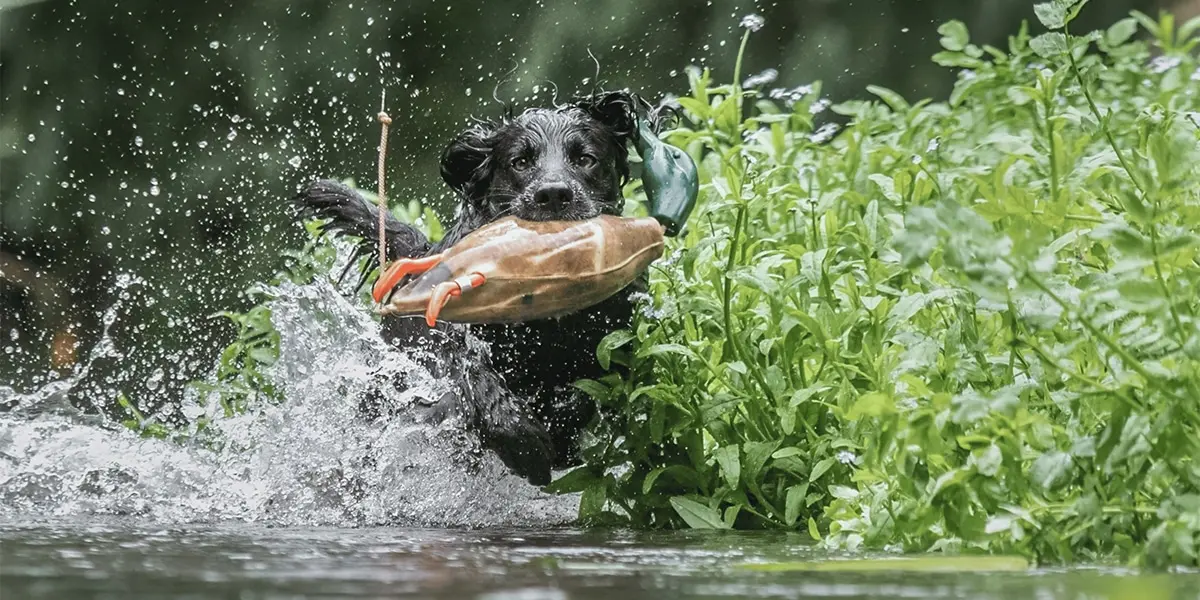
Gundog Water Training: How to Train a Confident Swimming Dog (UK Guide)
This is the honest UK handler's guide to gundog water training: how to introduce a gundog to water without ruining the dog, the entry-point rule, the shake-before-delivery fix, blue-green algae safety, and breed-specific notes for Labradors, Spaniels, HPRs and Chesapeake Bay Retrievers. April and May are the months that make a bold swimmer for the rest of the dog's career.
How to train a gundog to swim (water training in 5 steps):
- Pick a shallow gravel-bank entry, not a steep drop-off
- Use a buoyant water dummy, throw three feet first
- Build distance gradually (3 ft → 5 ft → 8 ft → 15 ft over sessions)
- Train the shake rule: delivery first, shake after
- Five retrieves, ten minutes, end on success
Written by UK gundog handlers and trainers working regularly with working-line Labradors, Springer and Cocker Spaniels, HPR breeds, and specialist water dogs (Chesapeake Bay Retriever, Hungarian Wirehaired Vizsla). Cross-referenced with The Kennel Club's gundog working test standards and Environment Agency water-quality reporting on UK blue-green algae blooms.
I watched a bloke throw a ten-month-old Cocker into a reservoir last April. Picked her up, walked her to the edge, swung her twice, and launched her about four feet out into cold water she'd never seen before.
Her eyes went the size of saucers on the way out. She paddled back in a panic, scrabbled up a muddy bank, and sat shaking at his feet looking genuinely betrayed. She never swam willingly again. He sold her on by September as "not really keen on water." I'd have sold him on instead, but I'm not in charge.
That, in one unpleasant anecdote, is how you ruin a dog for water in under thirty seconds. April and May are the most important months in the gundog year for anyone with a young dog, or a dog you haven't yet properly introduced to water.
Get the foundation right now and you'll have a bold, confident, launching swimmer by the time the first September duck flight comes round. Get it wrong and you'll spend the rest of the dog's career papering over the cracks.
Why Gundog Water Training Builds Water-Lust, Not Obedience
Short answer: a dog that is forced into water will never be a confident swimmer. The goal is enthusiasm, not compliance. Build a dog that launches because it wants to, not because the alternative is being thrown in.
You are not training compliance here. You are building enthusiasm. Every session in the first weeks of water work is about the dog thinking this is the best bit of my week. Any shortcut that compromises that feeling is a shortcut that costs you a proper water dog for the next ten years.
Patience is the whole game. If the dog is hesitant on session one, good. Let them be hesitant. Sit on the bank, throw a dummy three feet in, let them stand in the shallows, reward every small step forward, and walk away while it's still fun.
You don't need the dog swimming on day one. You need the dog wanting to come back tomorrow.
How to Introduce a Gundog to Water (Best Entry Points)
Short answer: a shallow, gently sloping shingle or gravel bank running into clean still or slow-moving water. The dog walks in to chest depth over four or five steps, then finds itself swimming almost by accident.
Before you bring the dog out of the truck, you need to have chosen the right water. This is the single most common mistake in early water work for retrievers and spaniels.
You want a shallow, gently sloping shingle or gravel bank running into clean still or slow-moving water. A gradual entry where the dog can walk in to chest depth over four or five steps, feel the bottom under their feet the whole way, and then find themselves swimming almost by accident when the water gets a few inches deeper.
That is the ideal first-water introduction. Perfect for Cockers, Labradors, Spaniels, HPRs, every breed.
What you do not want for a first introduction:
- A steep bank with a drop-off. The dog goes from dry to out-of-depth in one panicked leap and spends the whole experience fighting for the surface.
- Muddy margins that stick to the paws. Dogs hate uncertain footing and associate it with the water itself.
- Fast-flowing streams or tidal water. Currents are terrifying to a dog that doesn't know what swimming is yet.
- Dark deep water where the dog can't see the bottom. Visual reassurance matters.
- Any water that smells off, looks scummy, or has a green film. Algae warning below.
A shallow clean stream beats a deep pretty pond every single time. Find one, get permission to use it, and make it your foundation-water spot for the first four to six sessions.
Choosing a Water Dummy for Gundog Training
Short answer: use a buoyant foam-filled water dummy with a brightly coloured face. Sits high on the surface, stays visible, builds confidence. A standard canvas field dummy sinks fast and confuses a novice.
Don't use a standard canvas field dummy for water work. A soaked canvas dummy sits low in the water, becomes hard to see, and sinks fast: exactly the wrong combination for a novice water dog.
Use a dedicated water dummy (foam-filled, buoyant, often brightly coloured on one face) that sits high on the surface and stays visible for as long as the dog needs to get to it.
Visibility builds confidence. A pup that can see the dummy bobbing three feet out is a pup that is keen to go and get it. A pup chasing a half-submerged dark object is a pup who is confused before he has even got his paws wet. Two quid on a proper water dummy is the best money you'll spend on water training for retrievers.
Throw short first. Three feet. Then five. Then eight. Build the distance over sessions, not over single throws.
How to Teach a Dog to Swim (Puppy Paddle to Level Stroke)
Short answer: the splashy puppy paddle is normal on the first 3 to 4 sessions. Build distance gradually (10 ft → 15 ft → 20 ft) and the dog naturally levels out, drops the front paws below the surface, and starts using the back legs for propulsion.
Watch a young dog's first proper swim and you'll see the same thing almost every time. The front legs come up high and start splashing, big vertical paddle strokes that throw water everywhere, drive the dog's chest up, and make the whole thing look like hard work.
That is the puppy paddle, and it is normal. The dog is using the front end like a set of oars because they haven't yet worked out how to use the back end.
You don't need to correct it directly. What you do is build distance and duration gradually. As the retrieves get longer (10 feet, 15, 20), the puppy can't sustain the splashy high-front stroke, and the body naturally levels out.
The spine flattens horizontally, the front paws drop under the surface, the back legs start doing the actual propulsion, and the dog develops proper economical swimming posture. That transition usually happens somewhere between session four and session eight.
Dogs that stay splashy into adulthood are usually dogs who've only ever done short retrieves. Extend the distance gradually and the style sorts itself out.
The Shake Rule: Delivery First, Shake After
Short answer: the dog brings the retrieve out of the water, climbs the bank, walks straight to the handler, sits, delivers to hand. Only then is the shake allowed. Train this from the very first water session.
This is the one habit that separates a shoot-day disaster from a serious working water dog, and most amateur handlers never train it deliberately.
When the dog brings a dummy or a bird out of the water, the instinct is to shake before delivering. They are wet, they are uncomfortable, and a full-body shake is how a dog gets the worst of the water off.
Left untrained, the dog drops the retrieve, shakes vigorously, and then picks the retrieve back up to bring it to you. On a dummy that is fine. On a live warm bird, the dog has just dropped your shot pheasant in the margin of the water, shaken for ten seconds, and then gone back for it. Or possibly not gone back at all if the bird starts floating.
The rule is simple and absolute: delivery first, shake after. The dog brings the retrieve out of the water, climbs the bank, walks straight to the handler, sits, delivers to hand. Only once the handler has the dummy or the bird does the dog get to shake.
Train this from the very first water session by interrupting any shake-before-delivery attempt with a firm recall. Pair it with a rock-solid gundog stop whistle training and reliable gundog recall training so you have the verbal control to interrupt the drop-and-shake before it becomes habit.
Critical: a dog that drops a bird in the river to shake is a liability on any wildfowling trip or flight pond. The cure is months of work to undo. The prevention is ten seconds of consistent correction from day one.
Blue-Green Algae Warning for UK Gundog Water Training (2026 Update)
Short answer: blue-green algae blooms (cyanobacteria) are lethal to dogs, often within hours. If the water has a green film, foamy patches, or looks like pea soup: do not let the dog in. Check Environment Agency warnings before sessions on still water.
This is getting worse year on year. Every UK handler needs to be on top of it before they let a dog near standing water in spring and summer.
Blue-green algae blooms (technically cyanobacteria) produce toxins that are lethal to dogs, often within hours of exposure. Symptoms include vomiting, seizures, and liver failure. Treatment is largely supportive and outcomes are frequently fatal even with rapid veterinary intervention.
This is not a scare story. It happens across UK ponds, reservoirs, canals and some river stretches every summer, and the bloom season is lengthening with warmer temperatures.
Before any water session on still or slow-moving water:
- Look at the water. Green or blue-green film, foamy patches on the surface, pea-soup appearance, or discoloured scum along the margins: do not let the dog in. Full stop.
- Check warnings. The Environment Agency and local council publish water-quality alerts for known problem waters.
- Be cautious in hot spells after rainfall. Nutrient run-off triggers blooms.
- When in doubt, don't. The downside of a wasted training session is zero. The downside of an algae death is obvious.
Fast-flowing rivers and streams are typically safer because the current prevents the bacteria from colonising, but check for backwater eddies where stagnant water and algae can collect. Sea and brackish water are not affected by blue-green algae but have their own risks (rip currents, jellyfish, saltwater drinking leading to hypernatraemia). Know the water before you use it.
Post-Swim Care: Drying, Cold Tail, and Ear Infections
Short answer: dry the dog properly after every water session. A drying coat, a rough towel-off at the water's edge, and a dry kennel reduce the risk of Cold Tail (Acute Caudal Myopathy) and water-borne ear infections.
Even in warm weather, dry the dog properly after a water session. A wet dog that spends an hour in the back of a truck, or sleeps wet overnight in the kennel, is a dog at risk of chilling and at risk of Water Tail (also called Cold Tail, Limber Tail, or Acute Caudal Myopathy).
The tail goes limp, typically held horizontally for the first few inches and then dropping. The dog is clearly in pain when the tail base is touched. It is most common in working retrievers, particularly after hard cold-water sessions followed by insufficient drying.
Water Tail usually resolves on its own within three to seven days with rest and anti-inflammatories from the vet, but it is preventable and miserable for the dog. A decent drying coat, a rough towel-off at the water's edge, and sensible feeding and warmth after the session reduce the risk substantially.
Keep an eye on ear health too. Labradors, Cockers, Springer Spaniels and any breed with a drop ear is prone to water-borne ear infections if the ears aren't dried out after regular water work. A quick inspection after each session and a proper ear-cleaning routine once a week during water-training months will save a lot of vet bills later.
How Long Should Gundog Water Sessions Be?
Short answer: five retrieves, ten minutes, end on a success. A young dog called out of the water still wanting more is a dog who will sprint to the bank next session. Overdone sessions create reluctance, and reluctance is the first cousin of water-shyness.
The single commonest mistake handlers make in early water training (after the forcing-in disaster) is overdoing the sessions.
A keen young dog on their first proper swim is a joy to watch, and the temptation is to keep throwing the dummy because the dog keeps fetching it. Don't.
A dog who has done five cracking retrieves and been called out of the water while still wanting more is a dog who will sprint to the water's edge next session. A dog who has done twenty retrieves and been called out tired and cold is a dog who'll be reluctant next time.
Five retrieves. Ten minutes. End the session on a success, let the dog shake off and have a run about, and drive home. That is the template for the first month of water work. Duration and distance build naturally from there once the foundation is secure.
Best Gundog Breeds for Water Work UK
Short answer: Labrador Retriever for all-round water work, German Wirehaired Pointer for hard wildfowling, Chesapeake Bay Retriever for serious saltwater. The Hungarian Wirehaired Vizsla and Flat Coated Retriever also punch above average.
Some breeds are naturally water-obsessed. If you are buying specifically for wildfowling, cold-water retrieves, or marsh work, the shortlist is short:
- Labrador Retriever: all-round water work and proven cold-water tolerance. The default UK choice.
- German Wirehaired Pointer: dedicated wildfowling in the hardest UK conditions.
- Chesapeake Bay Retriever: serious saltwater work where no other breed quite matches the coat and temperament.
- Hungarian Wirehaired Vizsla: HPR with above-average water drive.
- Flat Coated Retriever: stylish retriever with strong water work.
When a Trained Water-Specialist Saves You a Year
Short answer: if you need a confirmed water dog for the September duck flight and you are reading this in July, training from scratch is not realistic. A part-trained or fully trained water-specialist is the honest route.
Building a confident water dog from scratch takes a full summer of patient short sessions. If your timeline is tighter than that, a trained dog with the foundation already done is the realistic option:
- Browse trained Labrador listings with proven water work
- Read the buy trained gundog UK 2026 guide for timing and red flags
- Understand training tiers: the part-trained gundog meaning guide
- Health paperwork before you commit: the gundog health testing guide
The Complete UK Gundog Training System
This water-work guide is one pillar of a control system. Each piece below stacks on the others:
- Gundog stop whistle training: the foundation control cue
- Gundog steady to shot training: hold position through shot, fall, and distraction
- Gundog recall training in the presence of game: reliable recall under pressure
- Gundog water training: this guide
- Summer roadwork and pad-hardening: the fitness side of summer prep
FAQs: Gundog Water Training
When should I introduce my gundog to water?
Quick answer: from 4 to 6 months for shallow paddling, full swimming sessions from 6 to 9 months. April and May UK temperatures are ideal for the first proper swims.
Earlier exposure to shallow puddles and stream margins from puppyhood builds general water comfort. Structured training swims start once the dog has basic obedience and retrieve foundations.
Why is my dog afraid of swimming?
Quick answer: almost always because of a bad first introduction: cold water, steep entry, being thrown in, or fast current. Fear is a learned response. Rebuild from a shallow gravel-bank entry with no pressure.
Some breeds (smaller terriers, breeds bred away from water) are less naturally inclined, but every working gundog breed should swim if introduced correctly. If the dog has already been frightened by water, expect 8 to 12 weeks of patient rebuild before normal swimming returns.
Can all gundogs swim naturally?
Quick answer: almost all working gundog breeds can swim, but enthusiasm varies. Labradors, Chesapeakes and Goldens are bred for water. Spaniels and HPRs need more careful introduction. Toy and short-legged breeds (Teckel) can swim but are not water-specialists.
Coat type matters. Double-coated breeds (Labrador, Chesapeake) handle cold water better than smooth-coats (Vizsla, Pointer). Always factor coat into session length on cold-water days.
How long does it take to train a gundog to swim?
Quick answer: a confident swimmer in 4 to 8 sessions of 10 minutes each over 4 to 6 weeks. Full retrieve-and-deliver water work in 8 to 12 weeks.
Labrador and Chesapeake-type breeds learn fastest. Spaniels and HPRs often need an extra month of confidence-building before the splashy puppy paddle settles into level swimming.
How do I stop my dog dropping the bird in the water to shake?
Quick answer: train the shake rule from session one. Delivery first, shake after. Interrupt every shake-before-delivery attempt with a firm recall and only release the shake command once the retrieve is in your hand.
Pair this with a solid stop whistle and recall. The verbal control is what lets you interrupt the drop-and-shake before it becomes a wired habit. Once habituated, the fix takes months of remedial work.
What is blue-green algae and why is it dangerous for dogs?
Quick answer: blue-green algae (cyanobacteria) produces toxins lethal to dogs, often within hours. Symptoms include vomiting, seizures, and liver failure. There is no antidote, treatment is supportive only.
If the water has a green or blue-green film, foamy patches, pea-soup appearance, or scum along the margins, do not let the dog in or near it. Check the Environment Agency warnings for known problem waters before any still-water session.
Which gundog breeds are best for water work?
Quick answer: Labrador Retriever for all-round work, German Wirehaired Pointer for hard wildfowling, Chesapeake Bay Retriever for saltwater. Hungarian Wirehaired Vizsla and Flat Coated Retriever for variants.
Coat type and breed temperament both matter. Double-coats handle cold better. Retrievers as a group out-swim Spaniels and HPRs as a group, but individual variation within breed is significant.
Is it safe to take a dog to a UK reservoir or canal in summer?
Quick answer: only if the water is clear and free of algae. Many UK reservoirs and canals develop blue-green algae blooms from late June through September, peaking after hot spells with rainfall.
Fast-flowing rivers are typically safer than still water. Always inspect the water visually before letting the dog in, and check local council and Environment Agency alerts for the specific water body.